Back to Top

Journal of archaeology and ancient architecture

Tag Archives: Puglia

Riflessioni sull’origine e sul significato del motivo dei gallinacei nella ceramica subgeometrica peucezia

Author: P. Palmentola

Download article as .pdf: Riflessioni sull’origine e sul significato del motivo dei gallinacei nella ceramica subgeometrica peucezia


The motif of the “poultry procession” is among the most representative decorative themes of bichrome subgeometric pottery from inland Peucetia during the central decades of the 6th century BCE. This motif departs from strict geometric compositions and is traditionally associated with contemporary Corinthian pottery, considered its primary source of inspiration. This study investigates the origins of the decorative motif by examining Greek productions that reached Iapygia during this period and opens reflections on its potential meanings. The stylised, non-naturalistic rendering of the animals makes their identification challenging; however, certain details point towards cocks and griffin-birds, allowing hypotheses on their significance. Moreover, with very rare exceptions, the motif depicts the birds facing right, a choice that, in light of ancient symbolic language, appears far from accidental. Finally, further analytical insights come from a depiction of backward-looking “poultry” found on an olla from Monte Sannace. Here too, it seems plausible to move beyond a purely decorative interpretation and to propose a reading imbued with deliberate meaning.

Pratiche rituali di quartiere. L’edificio V, 3 nel contesto delle insulae III e V dell’abitato di Monte Sannace

Author: P. Palmentola

Download article as .pdf: Pratiche rituali di quartiere. L’edificio V, 3 nel contesto delle insulae III e V dell’abitato di Monte Sannace (II metà IV secolo a.C.)
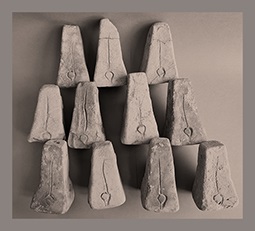
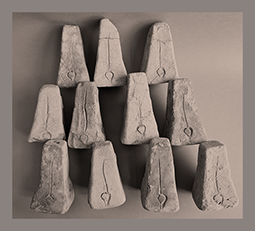
In the lower part of the Hellenistic settlement of Monte Sannace (Gioia del Colle, Bari) was found a square and large building consisting of a single room. It is supposed not to be a house, because of the objects found inside. Its main door/entrance is in a square and faces another building of equal size. The presence of a large entrance, a large hearth, numerous objects (such as loom weights, ‘temple keys’, mortars and ceramics for preparing, cooking and eating/drinking food, a few miniature objects, a large vase found upside down and with the mouth stuck in the ground) suggests that the building was used for non-institutional public rites, connected to a neighborhood community, perhaps linked to the funeral sphere and involving in particular women.
Le fortificazioni in Puglia tra età arcaica ed ellenistica. Un’analisi preliminare

Author: L.M. Caliò

Download article as .pdf: Le fortificazioni in Puglia tra età arcaica ed ellenistica. Un’analisi preliminare


The paper deals with fortified systems in Puglia trying to offer an organic picture of the phenomenon of fortifications. These seem to be concentrated mainly in two different periods, the Archaic age and the 4th-3rd century. In the first period the great aggere fortified systems was an important experience and manage the landscape of important settlements. The phenomenon of Hellenistic fortifications is more complex. In some cases, they resume traditional structures with a subcircular plan, but in others they experiment with new poliorcetic forms that derive directly from the research that the Hellenistic kingdoms of the West (Sicily and Epirus) were carrying out.