Back to Top

Journal of archaeology and ancient architecture

Tag Archives: Sicilia

Un dossier di appunti sul culto di Apollo archegete in Sicilia. Un culto tra Egeo e Mediterraneo

Author: V. Magro

Download article as .pdf: Un dossier di appunti sul culto di Apollo archegete in Sicilia. Un culto tra Egeo e Mediterraneo

The article is proposed as a dossier of notes, a corpus of news, hypotheses, studies, not without in-depth analysis, on issues still debated today by historians and archaeologists, on the foundation of Naxos of Sicily (734 BC) and on the presence of the undiscovered altar of Apollo Archegetes which can be found in the sources of Appian and Thucydides. Precisely Thucydides’ sources hand down an altar near today’s Schisò Bay which would soon have been elevated to a pan-Sikeliot cult, that is a cult recognized by all the people of Hellenic lineage who cohabited the island, as supported by historical I. Malkin and by the anthropologist M. Detienne. This would open up other lines of investigation still examined and discussed today, such as the presence of Nassi people in the first Hellenic colonial expedition to Sicily by the Euboeans and the probable function of oracle of Delos, even before that of Delphi, which will assert itself on the colonial horizon only starting from the first twenty-five years of the 7th century BC.

Intrecci rituali: nuove considerazioni sulla pratica funeraria dalla necropoli classica di Vassallaggi (Caltanissetta) attraverso l’analisi integrata di vecchi e nuovi dati

Authors: G. Longhitano, M. Primavera

Download article as .pdf: Intrecci rituali: nuove considerazioni sulla pratica funeraria dalla necropoli classica di Vassallaggi (Caltanissetta) attraverso l’analisi integrata di vecchi e nuovi dati

In the southern necropolis of Vassallaggi (Caltanissetta, Sicily), the practice of wrapping knives placed in male burials with textiles has been documented since the earliest published findings. Recent studies of textile traces preserved on knives exhibited at the archaeological museums of Agrigento and Caltanissetta have made it possible to identify new textile evidence on a knife from a female burial and to carry out a microscopic analysis of all textile remains identified within the necropolis. By integrating the results of microscopic observation with a renewed assessment of the archaeological data from the necropolis, this study aims to offer a reflection on funerary practices and the construction of social identity within a context of intense cultural interactions. Furthermore, the paper focuses on the selective use of linen textiles in funerary practices and explores how the new data help to address the current lack of archaeobotanical evidence concerning flax exploitation in Classical Sicily. Within this framework, the study also examines the discrepancy between textile evidence and the archaeobotanical record, in order to outline interpretative perspectives that may contribute to future investigations on flax production and circulation in the island.

Lilibeo-Marsala. L’area demaniale di via delle Ninfe. Nuovi dati dagli scavi degli anni 2024-2025

Autori: G. Polizzi, Manuela Rizzo, Maria Grazia Griffo

Scarica l’articolo in formato .pdf: Lilibeo-Marsala. L’area demaniale di via delle Ninfe. Nuovi dati dagli scavi degli anni 2024-2025

Between 2024 and 2025 the University of Palermo, in collaboration with the Archaeological Park of Lilibeo-Marsala, has conducted new archaeological investigations in the public area of via delle Ninfe (Marsala – TP). The research, still in progress, aims to study an urban domestic context in all its aspects and to contribute to the definition of the urban organization of the ancient city. After reviewing previous surveys in this area, this article presents the preliminary results of new research, providing a large amount of contextual data. The excavations have therefore allowed a stimulating re-reading of this sector of the city, returning an interesting stratigraphic succession relating to the life of Lilibeo from 4th century BC to the 3rd/4th century AD.

Anfore da trasporto come indicatori di rapporti commerciali nella Sicilia centro-settentrionale (VI-IV sec. a.C.). Il contributo del sito indigeno di Terravecchia di Cuti (PA)

Authors: B. Bechtold, A. Burgio

Download article as .pdf: Anfore da trasporto come indicatori di rapporti commerciali nella Sicilia centro-settentrionale (VI-IV sec. a.C.). Il contributo del sito indigeno di Terravecchia di Cuti (PA)

This paper focuses on a selection of 82 transport amphorae discovered at the indigenous hill site Terravecchia di Cuti (PA) located in central Sicily. The materials found in the urban area of the settlement date back to the 6th-late 4th centuries BCE. The majority of the items have been studied using standardised methods implemented for the data base of FACEM. Additionally, a group of 23 fragments has been submitted to minero-petrographic analyses, with preliminary results being presented in this contribution. This interdisciplinary approach has led to the provenance attribution of a representative selection of amphorae, which originates from a surprisingly large geographical area spanning from the Aegean region in the East to Punic Sardinia in the West. Among the most important scientific outcomes is the identification of a large group of western Greek amphorae produced in Himera, which underlines the site’s close connection with this northwestern Sicilian town. The present research offers diverse perspectives that contribute to a more nuanced understanding of Cuti’s commercial interaction with both Greek, but also the indigenous sites. Provenance analysis of amphorae can be regarded as an innovative tool for studying some aspects of the complex issue regarding socio-economic relations between the native and the colonial world of Archaic and Classical Sicily.

La scultura di Magna Grecia e Sicilia e la mobilità degli artigiani fra testimonianze scritte e documentazione archeologica

Author: R. Belli

Download article as .pdf: La scultura di Magna Grecia e Sicilia e la mobilità degli artigiani fra testimonianze scritte e documentazione archeologica

The paper intends to propose a reflection on the phenomenon of the mobility of ancient sculptors, with particular reference to the Western Greek context. Literary and epigraphic sources attest individual mobility of artists as early as the 7th BC, with a progressive increase over time. In this context, artists from Magna Graecia and Sicily are documented, engaged in both micro- and macro-mobility, as well as “external” artists receiving commissions from Magna Graecia poleis in Panhellenic sanctuaries. Equally important, especially for the purposes of the dissemination and transmission of technical knowledge, is the role of itinerant workshops, whose presence is documented in certain cases, by specific types or classes of materials; certainly, a greater knowledge and an in-depth study of the organisation of these productive units, also in relation to the sources of supply, would be of great use. Finally, the role of the client and the way in which he implements his choices should also be better understood.

Una città nella città. Forma e funzione delle acropoli nelle colonie greche d’Occidente: i casi di Cuma, Siracusa, Taranto e Neapolis

Authors: V. Parisi, A. Averna, M. Crisci, R. Perrella

Download article as .pdf: Una città nella città. Forma e funzione delle acropoli nelle colonie greche d’Occidente: i casi di Cuma, Siracusa, Taranto e Neapolis

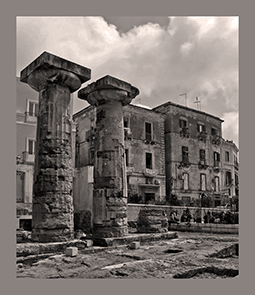
The paper presents the preliminary results of the research project “AKROMA. Akropolis of Magna Graecia. A critical ‘top-down’ view on Landscape, Architecture and Cult Network in the Western Greek Colonies” – University of Campania “L. Vanvitelli”. Starting from four carefully selected key sites (Cumae, Syracuse, Taranto, Neapolis), the theme “acropolis” in the Greek colonies in Magna Graecia and Siciliy, which had been never investigated systematically before, has been object of a wide-ranging analysis, whose goal was to identify its peculiarities from a specific Western Greek point of view. Emphatic and strategic places due to their morphological and orographic features, acropolises are arranged as “city within a city”: they are well-defined and separated areas, protected by natural defenses, which at the same time projected outwards (the sea, the lower city, the hinterland) and were always characterized by public, collective and representative functions. Their role, both concrete and symbolic, developed around two main functional poles, the religious one (as the site of the oldest city temples) and the political/military one (particularly emphasized with the development of polyorcetic techniques in the Hellenistic age). Thanks to the comprehensive reinterpretation of archaeological data and the emancipation from the motherland models, colonial acropolises can thus regain space and significance in the urban history of the Western Greek poleis.

Dal monumento al segno grafico: il teatro di Taormina nei disegni dei Pensionnaires tra XVIII e XIX secolo

Author: S. Calò

Download article as .pdf: Dal monumento al segno grafico: il teatro di Taormina nei disegni dei Pensionnaires tra XVIII e XIX secolo

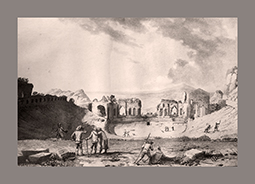
The study of ancient architecture by French architects was promoted through the funding of a scholarship to travel to Italy, guaranteed only to the winners of the Grand Prix de Rome. The pensionnaires who enjoyed this privilege went to Rome and some of them went beyond the Latium territory to reach Sicily. In particular, we analyze some drawings of the Taormina theater preserved in the archive of the École Nationale Supérieure des Beaux-Arts in Paris and made between the 18th and 19th centuries by Houël, Renard, Blouet and Duc. Comparing the drawings, similarities and differences emerge in the way of representing ancient architecture and the landscape context: an interdisciplinary perspective is necessary which enhances the technical and expressive peculiarities of each pensionnaires, placing them in relation to the question of travel, to the travel journals of architects and to the restauration of ancient monuments.

La Valle dopo gli antichi. La campagna di scavi del 2019. Parte I

Authors: V. Caminneci, L. Piepoli, G. Scicolone

Download article as .pdf: La Valle dopo gli antichi. La campagna di scavi del 2019. Parte I


We present some archaeological investigations carried out in Agrigento on Summer 2019, within the project entitled “The Valley after the ancients”. The aim is to reconstruct the post-antique phases of the Valley of the Temples, including the most recent history until the public opening of the cultural site. The digs have been carried out in some points selected in order to achieve the diachronic investigation. Following an interdisciplinary research, through the indirect sources as well as the archaeological ones, a careful review of the known data has been accompanied by the study of archive documents and especially of the old photographs, which portrayed the lost landscape of the Valley of the Temples.

Alla ricerca di ‘case sacre’ tra Sicilia e Magna Grecia. Per una nuova prospettiva sull’esperienza religiosa nell’Occidente greco, tra ipotesi di lavoro e riflessioni di carattere metodologico

Author: Marco Serino

Download article as .pdf: Alla ricerca di ‘case sacre’ tra Sicilia e Magna Grecia. Per una nuova prospettiva sull’esperienza religiosa nell’Occidente greco, tra ipotesi di lavoro e riflessioni di carattere metodologico


Some religious practices in Magna Graecia and Sicily are strictly related to civic associations and they seem to have very peculiar features. Within these phenomena that belong – like the official polyadic cults – to the complex and varied ‘mosaic’ of religious experiences of the Western Greek colonies, it is possible to include also the so-called ‘sacred house’. These ‘ierai oikiai’ were probably used to host meetings of some small communities belonging to phratriai or other similar local civic associations and family clans. Based on these premises, this paper offers a preliminary survey of all the archaeological contexts within the Western Greek colonies that potentially deserve to be reconsidered from a new hermeneutic perspective. A reappraisal of some buildings through spatial, context and functional analysis allows to appreciate the constant occurance of some common elements within the ‘sacred houses’. Renewed archaeological considerations, together with some socio-anthropological, epigraphic and historical data, contribute to support how it is necessary and urgent to rethink again the concept of “sacred space” in the ancient Greek community, which was often wrongly conceived within the canonized limits of the official sanctuaries. Furthermore, the case-study of the ‘sacred houses’ requires an in-depth rethinking on the category of the household ritual activities, usually limited to religious practices carried out on a personal and private level.


Segesta e il mondo greco coloniale attraverso lo studio delle anfore greco-occidentali da aree sacre: primi dati

Authors: M. de Cesare, B. Bechtold, P. Cipolla, M. Quartararo

Download article as .pdf: Segesta e il mondo greco coloniale attraverso lo studio delle anfore greco-occidentali da aree sacre: primi dati


This research focuses on western Greek wine amphorae found in Segesta, in two Archaic-Classical sanctuaries which have provided still unpublished archaeological data: the sacred area of the Northern Akropolis documented by the so-called Grotta Vanella dump and the extra-urban sanctuary of Contrada Mango. The amphorae fragments have been studied according to the standardised methods implemented for the data base of FACEM and attributed to more or less-known typologies and provenances. The study of these finds has been accompanied by a systematical review of all published western Greek amphorae yielded by the stratigraphical excavations undertaken in the 1990ties in some urban areas of Segesta. This analysis has led to a better understanding of the commercial vectors and the mechanisms of purchase of these vessels in the Elymian town against the background of the circulation of this class in Sicily and southern-central Mediterranean. Furthermore, the contextualisation of the new data within the frame of the two sanctuaries has allowed for a more precise and diachronic definition of the containers’ role and their contents in the ritual practices. It has also clarified certain dynamics of contact between Segesta and the Greek milieu and the cultural interaction between the Greek and the ‘Indigenous’ population, ritualised within the two sacred areas.