Back to Top

Journal of archaeology and ancient architecture

Tag Archives: tombe intra moenia

Il Complesso a Ovest della Casa delle ghirlande a Solunto

Author: V. Polizzi

Download article as .pdf: Il Complesso a Ovest della Casa delle ghirlande a Solunto

The archaeological site of Solunto (Sicily) has in recent years been the subject of interesting contributions from scholars who have tried to review the numerous monuments brought to light by excavations in nineteenth and twentieth centuries and never, apart from a few limited exceptions, examined in detail. This is the case of the “Complesso a Ovest della Casa delle ghirlande”. Located on the northern edge of the relief that hosts the settlement, but at the same time in an area close to the main public and sacred buildings of the city, the complex is one of the first monuments brought to light by extensive excavations conducted by Vincenzo Tusa on the site from the middle of the last century. The area, known for the discovery of two intra moenia burials, has never been analyzed in detail, which is why, apart from a few sporadic hints, it is completely unpublished. Considering the scarcity of information offered by the published contributions and the absence of stratigraphic data, the study of archival material combined with the analysis of archaeological evidence in situ and that, albeit partial, of material culture, made it possible to advance some hypotheses regarding the chronology of the complex and its possible identification with an heroon or a Memorialbau.

Morte e memoria. Osservazioni sulle sepolture di personalità eminenti in associazione a edifici ginnici e agonistici
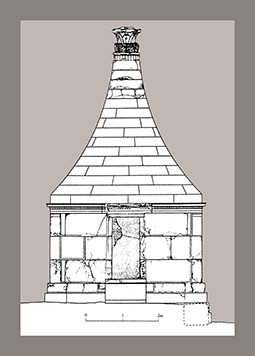
Author: R. Sassu


Download article as .pdf: Morte e memoria. Osservazioni sulle sepolture di personalità eminenti in associazione a edifici ginnici e agonistici


In the framework of the topic concerning monumental tombs located within the urban space, outside the necropolis, a specific issue regards the identification of the spot where such edifices, exceptionally located inside traditionally forbidden areas, are built. The choice of associating the mausoleum to structures related to the concepts of glory and eternity is often expressed by the spatial and topographical connection between the sepulcher and structures devoted to sport and military training, as well as competition, particularly stadia and gymnasia, as testified by the case studies provided by Messene, Calydon, Miletus and Gortyn of Crete. The phenomenon – that usually aims to praise those who benefited the society through miliary or agonistic victories or euergetism acts by granting them an excellent tomb – is not restricted to the Hellenic world, but widely spread in the Roman provinces.