
Author: G. Furlan
Download article as .pdf: Aspects of circular economy on an urban and inter-urban scale in the Roman age: towards a more holistic model
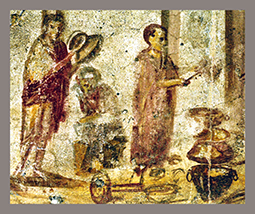 During the last few years, interest in reuse practices in the Roman world has received increasing attention. On the other hand, the debate concerning the sustainability of contemporary economies has led to the refinement of theoretical tools such as that of circular economy. The paper examines, in the light of a circular economic framework, those aspects characterizing the Roman urban economy as circular. A series of activities and agents, sometimes leaving little archaeological footprint, reduced waste and optimized the use of fresh resources on a daily basis. These activities (maintenance, repair, secondary use, lateral cycling, recycling etc.) involved a wide range of materials and, far from occasional, they were well integrated into the so-called linear economic model (production, distribution, consumption, and discard). Although the available data are still fragmentary, this systematic review demonstrates that circular economy must be steadily included in the current narratives of Roman urban sites. Economic reasons seem to play a major role in moving the Roman urban circular mechanism; nonetheless, it also emerges a forma mentis putting the object at centre, and not its economic, monetary value. Quantifying the overall impact of circular practices in the Roman urban economy still represents a major challenge, but the data so far collected point to a significant influence.