Back to Top

Journal of archaeology and ancient architecture

Tag Archives: teatro

La palestra/ginnasio di Solunto: nuovi dati per lo studio del complesso

Author: V. Polizzi

Download article as.pdf: La palestra/ginnasio di Solunto: nuovi dati per lo studio del complesso

The gymnasium/palaestra of Soluntum (Sicily) constitutes one of the most significant monuments of the settlement on Monte Catalfano and, at the same time, one of the few contexts within the public area that has not yet been subjected to a critical reassessment. Brought to light by V. Tusa during the extensive investigations conducted at the site from the mid-twentieth century onward, the building was the subject of more recent research in the early 2000s by A. Mistretta, who also carried out several trial excavations, whose results have not, however, been presented in a detailed publication. Consequently, numerous questions remain open regarding the building phases of the complex and the topographical context in which it is situated. The latter, owing to the complexity of the documented building stratifications, plays a central role in understanding the urban development of the settlement and, in particular, the evolution of its public area. The contribution aims to re-examine the data published thus far on the complex, drawing on new evidence obtained through the autoptic study of remains in situ and through an analysis of the relevant topographical context. The objective is to provide new elements for understanding the building interventions that affected this sector of the public area and to propose a more precise chronological framework for the monument.

Dal monumento al segno grafico: il teatro di Taormina nei disegni dei Pensionnaires tra XVIII e XIX secolo
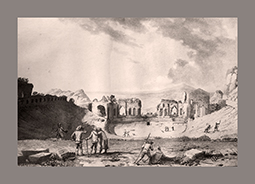
Author: S. Calò

Download article as .pdf: Dal monumento al segno grafico: il teatro di Taormina nei disegni dei Pensionnaires tra XVIII e XIX secolo

The study of ancient architecture by French architects was promoted through the funding of a scholarship to travel to Italy, guaranteed only to the winners of the Grand Prix de Rome. The pensionnaires who enjoyed this privilege went to Rome and some of them went beyond the Latium territory to reach Sicily. In particular, we analyze some drawings of the Taormina theater preserved in the archive of the École Nationale Supérieure des Beaux-Arts in Paris and made between the 18th and 19th centuries by Houël, Renard, Blouet and Duc. Comparing the drawings, similarities and differences emerge in the way of representing ancient architecture and the landscape context: an interdisciplinary perspective is necessary which enhances the technical and expressive peculiarities of each pensionnaires, placing them in relation to the question of travel, to the travel journals of architects and to the restauration of ancient monuments.
Das römische Theater von Mogontiacum (Mainz): Typologische Überlegungen mit Blick auf den regionalen Kontext

Author: M. Teichmann

Download article as .pdf: Das römische Theater von Mogontiacum (Mainz): Typologische Überlegungen mit Blick auf den regionalen Kontext


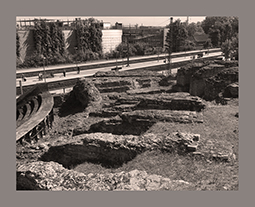
The probably largest Roman theater north of the Alps was located in Roman Mogontiacum (today‘s Mainz). Already in the late 19th and early 20th century, the site was partially excavated, documented and destroyed. Recent research was initiated in the late 1990s and resulted in the partial excavation of the monument. Despite the new field research and the importance of the building in Antiquity, the theater has been given relatively little attention in modern research discussions, or has sometimes been discussed under incorrect assumptions, based on the obsolete state of research. The present paper focuses on the typological comparison with other theaters in the region (primarily the province of Germania superior). The theater of Mainz was outstanding in various ways, based on architectural ornamentation influenced by Mediterranean models, its type, size and its very early construction date. The particular role of the theater is mainly due to its presumed function in the context of the memorial events for Nero Claudius Drusus, political gatherings and the presence of the Roman army.

(Italiano) Arredo urbano e rappresentatività pubblica e privata: il caso dell’Apulia meridionale in età tardo repubblicana e imperiale

Author: R. Belli Pasqua

download article as .pdf: Arredo urbano e rappresentatività pubblica e privata: il caso dell’Apulia meridionale in età tardo repubblicana e imperiale

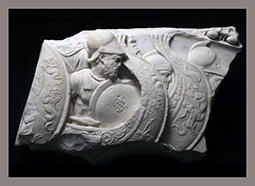
The study investigates the Roman sculpture from Taranto, Lecce and Brindisi; although in many cases it is difficult to trace the pertaining original contexts, the preserved documentation allows us to analyze how the sculptural decoration was used to meet the needs of public and private representativeness. The ideal sculptures, realized in function of the great monumental complexes built starting from the Augustan age (celebratory complexes, theaters, thermae, amphitheaters), show the adhesion to the political and cultural guidelines enacted at central level, while the iconic statuary documents the choice of public areas or highly representative buildings, aimed at building consent, so as to create those “figurative spaces” through which the city celebrates itself and its citizens. Iconographic schemes and reference models attest the full adherence to the cultural models proposed by the imperial authority.